Showing posts with label Alon Levy. Show all posts

Thursday, January 23, 2014

An Along the Shore HSR Program

Yesterday, Alon Levy offered a critique of the Regional Plan Association's Metro-North critique. As this post is framed in the context of his Northeast Corridor--and especially his Connecticut--recommendations, it aims to do two things: clarify visually his ideas, and offer my own.

The Along the Shore Line
Figure 1. The NEC from New York to Providence, with incremental improvements
The "Along the Shore" Line is the name I have heard given to the New Haven's (NH) principal mainline through Connecticut, running, well, along the shore. In Figure 1, above, Along the Shore is the thin red line; the blue blisters are various HSR bypasses of curvature or clearance issues; and the placemarks are important standalone features. See the map here.
Figure 2. Shell Interlocking. Flat junction; reverse curvature
Working from west to east, the first major feature is Shell Interlocking, where the Hell Gate line--the NH's connection to the former Pennsylvania Railroad--meets the NH mainline, which connects to the former New York Central Railroad in nearby Mount Vernon. Shell (Fig. 2) is a flat junction in a reverse curve; to ensure good performance, track straightening is needed, as is a flyover or duckunder for conflicting moves.
Figure 3. Port Chester bypass alignment. Cos Cob is dot upper right
North of Shell is the first major bypass of NH curves, at Port Chester. This bypass begins just east of Rye Station (new interlocking RYE) and follows I-95 as a bypass of three major curves and a moderate one through Port Chester and Greenwich before returning to the mainline just west of Cos Cob station (new interlocking COB) (Fig. 3).
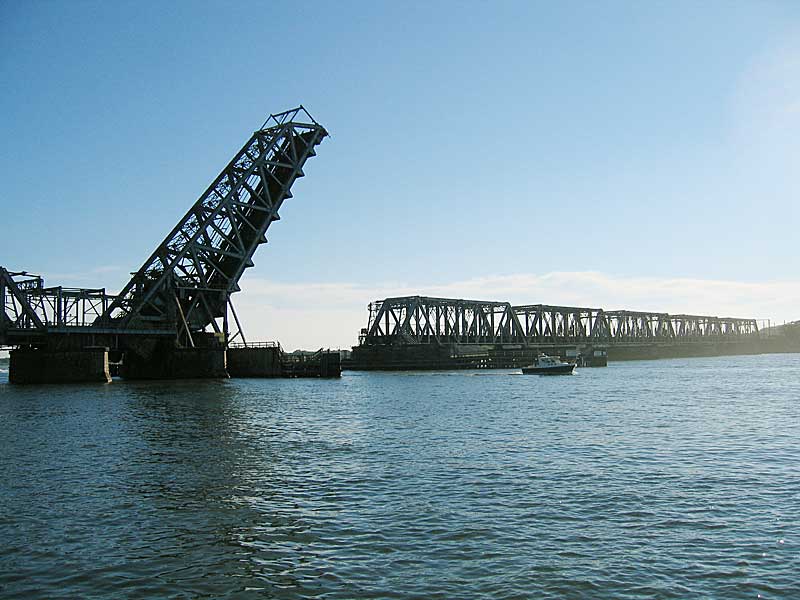
Figure 4. Cos Cob Bridge
The Cos Cob bridge over the Mianus River is the next placemark (Fig. 4). This bridge is an aging bascule bridge; as HSR cannot afford delays due to lift bridges, this needs to be replaced, and raised to allow marina traffic to clear the span.

Figure 5. Noroton bypass
East of Stamford is the second major bypass, at Noroton (Fig. 5). This begins just east of Stamford yard (at new interlocking NOROTON) and bypasses the flat junction Glenbrook Interlocking and curvature associated with it (Fig. 6, below).
Figure 6. Glenbrook Interlocking
This bypass terminates just east of Darien (at new interlocking DARIEN), where it connects to the mainline and also to Norwalk bypass (sub.). This is because Noroton bypass is meant to be used not just by nonstops, but also by limited-stops that stop at Norwalk and Stamford, but none of the intervening stops, thereby relegating the flat junction to locals.
Figure 7. Norwalk bypass
From Darien Interlocking, the Norwalk bypass extends along I-95 through Norwalk (Fig. 7). This bypass eases some sharp curvature just west of town.
Figure 8. Walk Bridge
But more importantly, it bypasses Walk (Fig. 8) and Saga (Fig. 9) bridges across the Norwalk and Saugatuck rivers, respectively.
Figure 9. Saga Bridge
That it does the latter is a quirk of geometry--but it also means that neither bridge will carry HSR.
Figure 10. Bridgeport bypass
Bridgeport has a pair of severe curves on either side of its station. I-95 also has a moderate curve here; mitigating this will require a new easement (Fig. 10) from just prior of the south curve (new interlocking BRIDGE*) to just west of Stratford station (new interlocking PORT).
Figure 11. Peck Bridge
Incidentally, this will require a fixed-link bypass of Peck bridge across the Pequonnock river (Fig. 11).
Figure 12. Devon Bridge
Northeast of here is Devon bridge across the Housatonic (Fig. 12). This bridge, like the Cos Cob bridge, needs replacing and raising, in order to be a fixed link.
Figure 13. Ferry Street junction
While New Haven is all-stops, and this observation is relatively minor, it is worth noting that the junction under Ferry Street (Fig. 13) is, unsurprisingly, flat.
Figure 14. East Haven easement issue
A new easement is needed just east of New Haven, due to two other reasons: (a) the curve from New Haven to East Haven needs bypassing, and (b) the I-95 alignment does not offer a viable substitution. Fig. 14 shows a the tangent such an easement would roughly need to follow.
Figure 15. Long bypass
The Long Bypass is the longest of the major bypasses (Fig. 15). Its length is due to two facts: (a) the Along the Shore east of Old Saybrook is marked by a combination of lift bridges and sharp curvature, and (b) the replacement alignment, I-95, follows a markedly inland course. An issue of note is the "hump" above the Niantic river, where 95 converges with 395. A virgin easement may be required across the Niantic's top--fingers crossed, I hope not.
Figure 16. Connecticut River Bridge
Figure 17. Niantic River Bridge
Figure 18. Mystic River Bridge
Three of these bridges (Figs. 16, 17, and 18) cross the Connecticut, Niantic, and Mystic rivers, respectively.
Of particular interest is the fourth crossing (Fig. 19) of the Thames River.
Figure 19. Thames crossing alignments
Figure 20. Thames Bridge
This is because of two reasons: (a) the Long Bypass and Along the Shore at at their closest here, and (b) the old bridge (Fig. 20) can be replaced with a high-span fixed link that accommodates both expresses (utilizing the Long Bypass) and regionals (utilizing Along the Shore). Space is available for bridge spirals, thereby reducing the amount of times the old bridge--now utilized by freight--needs to be opened.
Figure 21. Rhode Island easement concern?
A final note (Fig. 21) pertains to a couple of moderate curves in rural Rhode Island, north of Charlestown. While replacement is not necessarily a priority, takings are inexpensive here, and a straighter easement (such as along my tangent line) could be developed.

Past this point, the line has excellent track geometry--the Acela hits its full speed here--north to Providence. Providence has some curvature issues of its own, but we'll talk more about those later.
___________________
*Which would also replace current Port Interlocking in functionality, incidentally.

Saturday, July 6, 2013

More Cogent than I

While still an undercurrent in urbanist media, people are starting to take note of our fundamentally broken approach to passenger rail safety. This item from the usually-libertarian Competitive Enterprise Institute, for example, hits the nail on the head. It's extremely short, only seven pages, and describes more cogently and Steve Smith, or Alon Levy, or I, the challenges facing American rail transportation professionals.

The problem remains that this remains an issue that is unknown, and hence unremarked-on, by most people outside the profession and geeks whose interests tend that way. It also doesn't help that, as Business Insider points out, politics get in the way. This is an ongoing problem with land-use issues: it is very difficult for technocrats to reevaluate and rebuild fundamentally broken regulations when they are opposed by people who know those regulations are broken, and fundamentally just don't care, who would rather leave them in place to laugh at them and say they should be repealed outright* and say "this is why government is broken" rather than pitching in, lending a hand, and fixing them.

All that said, I find myself nodding in agreement with Edmonson and Scribner in their recommendation that
[i]f the FRA insists that the operational environment of the Untied States is uniquely dangerous, it should overhaul its regulatory mandates and take a step back from the prescriptive rules currently in place. Instead, it should create a series of performance metrics that would allow train designers to innovate. It now asks, “Does this train fit our rules?” It should ask, “Is this train survivable in a crash?”
 
This would allow U.S. transit authorities to purchase not only European trains, but also Japanese trains, which are designed to different effective standards. The United States could be a melting pot of train designs from around the world.
It can be done. But do we have the political will to do it?
______________
* Although, with the current FRA regulations, and the (nonexistent) state of our domestic passenger railcar industry, one can actually argue for its dissolution (as Alon Levy has in the past); European and Japanese products, the bulk of the market, have proven safety records our lemons don't.

Monday, June 20, 2011

Idle Thoughts

Idle Thought #1: In Alon Levy's latest post, he argues that international intercity links of all stripes underperform their domestic counterparts. Hence a Seattle-Vancouver link would underperform relative a Seattle-Portland one, even though Vancouver's closer. The argument is convincing.

However, he makes a point he doesn't really take up again, namely that "Eurostar’s mode share is quite normal by the standards of other HSR lines of comparable travel time". Since the market's undersized, the total ridership on the high-speed line will likewise be undersized...but the fact that London-Paris Eurostar commands an equivalent mode share (as measured by percentage of trips taken per mode used) in its market as, say, the Paris-Brussels Thalys does in its market, offers a key into how we want to do ridership projection modeling for intercity high-speed service--namely, we want to create a model which prioritizes mode-share rather than just an absolute count of riders. Knowing the size of the current travel market (in terms of total trips taken), the size of the mode share being aimed for, and the average ridership per trip, we can actually create an extremely simple and effective model for figuring out whether a particular market is profitable for high-speed rail relative to ridership. Secondly, since most rail lines are actually linked corridors, finding the mode share for each significant intercity pair, extrapolating ridership, and then adding it all up into a combined ridership (for example, the mode share of D.C.-N.Y. = mode share of D.C.-N.Y. + D.C.-Philly + D.C.-Baltimore + N.Y.-Philly + N.Y.-Baltimore + Philly-Baltimore) should create a powerful, effective mechanism for ascertaining projected ridership.

For example, let us assume the travel markets between Cities A, B, and C are all 10 million, and the mode shares for City A-City B and City B-City C are 70% rail, 20% air, and 10% road (relatively common for intra-megalopolis travel), while City A-City C is 50% rail, 40% air, and 10% road (think Tokyo-Hiroshima). 70% of 10 million is 7 million, and 50% 5 million. Hence total ridership on the line connecting Cities A and C via City B will be 7m + 7m + 5m = 19m, which, if I remember correctly, should be a rough estimate of the total ridership of the Tokyo-Osaka-Hiroshima shinkansen, or perhaps the TAV between Milan and Naples via Rome.

Idle Thought #2: In today's Sunday Train, Bruce McF mentions that "whenever a Republican passes over the opportunity to propose regulatory reform, it seems worthwhile to look at what regulatory reform might have to offer". This falls squarely into my overarching narrative of how modern Republicans (most lately under the guise of the Tea Party) are using populist-libertarian ideology to shroud and advance corporatist interests, and furthermore that the Tea Party ideology is in fact only made possible due to a now-generation-long collusion between corporate conservatives and televangelists, and that elements of televangelical* culture, such as those which create the whole astroturfed "controversy" between evolutionary theory and creationism intelligent design, demonstrate clear cultural values in anti-intellectualism and dogma acceptance...or, to put it another way, their "real world" is quite different from ours.

Anyway, sidetrack aside, "whenever a Republican passes over the opportunity to propose regulatory reform," considering that true libertarianism is always anti-regulatory in nature, this offers a clue into real motives. While the libertarian argument is that regulation is always bad, due to it detracting from the ability to do business, the progressive counterargument is that regulation, when properly done, is a sort of legal referee making sure the public get what they think they're getting when they get something. After all, we'd rather not buy a burger full of shit or poisoned rat carcasses. So, when an ostensibly anti-regulation politician passes on the chance to tackle regulatory reform head-on--and on regulation that is widely considered, across the political spectrum, to be broken, at that--to score political points in a vainglorious attempt to undermine Amtrak's political coalition, we can be sure something's going on, and the public's best interests are not being properly represented. Even the Department of Transportation's own recent FRA reform was exceedingly tepid, especially for a regulatory framework so baldly, badly broken by international standards. Someone wants the current regime to stay in place--who? A special-interest coalition, I bet, of (a) the freight railroads, (b) AASHTO, and (c) unions (who see "Buy America" as ensuring work)**. The result? A promulgation of the broken status quo.

One thing we can be rest assured of, however, is that the Tea Party and our politicians are making such a mockery out of libertarian thinking it's damaging real libertarianism (of the Market Urbanism kind) and progressivism alike.
____________
* That is, the culture of Billy Graham-style evangelists.
** In direct contravention to the let-it-go-it'll-work style of libertarian thinking. Actually, bringing American rail regulation in line with UIC standards and eliminating Buy America will almost certainly create more jobs than it eliminates--because it allows the tools to start creating more passenger rail in a country where so much of it has been lost, and once enough potential buyers are in place, the domestic industry will follow. The current regulatory environment is very much putting the cart before the horse--no wonder it fails so hard!

Friday, May 27, 2011

FRA Is The Problem With American Railroading

I'd just like to permalink to Alon Levy's latest post. He hits the nail right on the head as regards American railroading and the woeful state of regulation this side of the Atlantic. In particular two passages stand out to me:
Under present FRA regulations, not much more than NEC service levels can be done: rolling stock would have to meet guidelines developed for the steam era, curve speeds would be limited, and the signaling would not provide enough capacity for adequate service levels on shared track. This is independent of the incompetence of every FRA-compliant railroad; in fact part of the incompetence is manifested in unwillingness to try to get waivers, even though Caltrain, a small operator, applied for a partial waiver and got it.
 and:
In contrast, no reform of the FRA is possible short of a complete overhaul. The appropriate passenger rail regulation in the US is that everything that’s legal in Japan or Europe is legal in the US, and the only local task should be a skeletal staff reconciling European and Japanese rules where necessary. A piecemeal approach leads to partial and suboptimal reforms, requiring additional testing of already extensively used trains.
Quoted for truth.