|
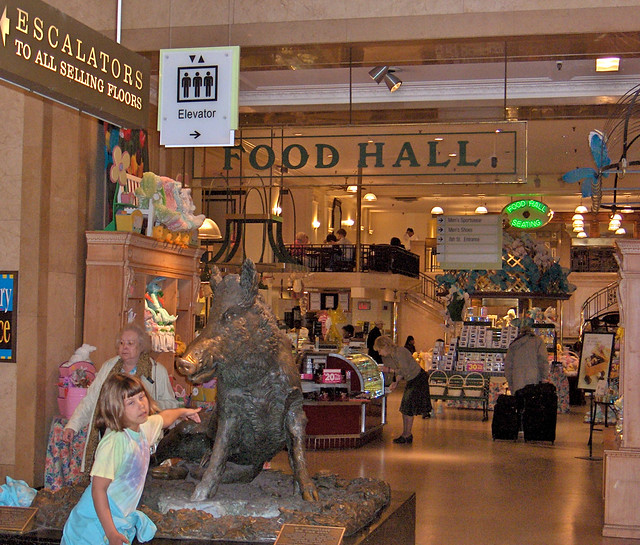
| Strawbridge's in better times. Courtesy Labelscar. |
As has been reported, the Philadelphia Inquirer and Daily News are moving, from their historical home at 400 North Broad (over former Reading tracks, across from Terminal Commerce, and next to its former printing press) to 801 Market.
 |
| 8th & Market back when it was bordered by half of the city's major department stores. Courtesy the Hagley Archives. |
801 Market is, of course, the Strawbridge's building. At its peak, it had eight floors of retail, a bargain basement, and four floors or so of corporate offices on top; when Strawbridge & Clothier was sold to the May Company, these top floors were sold to a separate company and Strawbridge's continued operating in its space below.
In the '70s, Strawbridge's and Gimbels partnered with the RDA and mall developer the Rouse Company to build the Gallery, then conceived as the first element of a then-decade-old Market East redevelopment framework. The first section was completed in 1977; the second section, with J.C. Penney as lead tenant, in 1983. For the first decade or so, the mall was a
major Philadelphia retail center; the high-end stores, such as Lord & Taylor and Saks Fifth Avenue clustered along the Golden Mile of City Line Avenue, but no mall could yet beat the great retail core of Market East.
 |
| Redevelopment is badly needed at the Gallery. This is the panorama one is treated to from Burlington Coat Factory's 3rd floor entrance. |
This began to change in the mid '80s, though, as Simon brought King of Prussia upscale. Even if a major push had been made to bring these stores downtown, the zeitgeist was all in the suburbs. And so King of Prussia added the Court, anchored by Macy's, Bloomingdale's, and a short-lived Abraham & Straus (which was in short order replaced by Strawbridge's, which in 1995 moved to the former Wanamaker's); added to that, Neiman Marcus and Nordstrom--then the
only ones in the region (Neiman Marcus still is)--and Lord & Taylor signed on to buttress Sears, Gimbels/Penney's, and Wanamaker's in the Plaza. The Gallery remained more or less stable, with the most change happening in the center anchor: after Gimbels' liquidation, it was replaced with Stern's, which, when it decided to pull out of the Philadelphia market, was replaced by Strawbridge's discount brand, Clover, which was then replaced by Kmart (now the Gallery's oldest anchor).
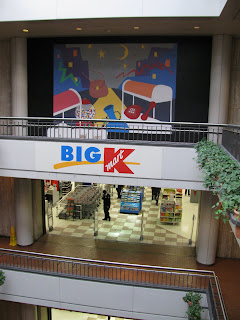 |
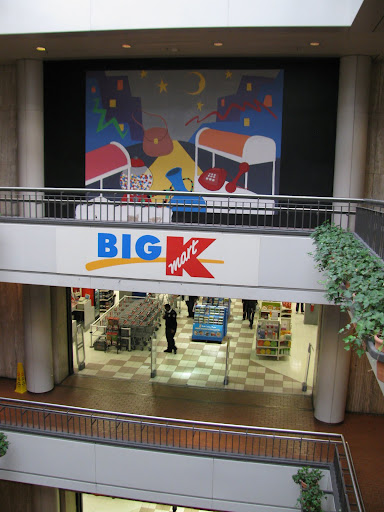
| Kmart's Gallery II entrance. The shut, mural-clad third floor entrance (closed off ca. 1990) leads to converted--and vacant--office space. Reactivating it for retail may be a possibility. |
2003 seems to have been a catalytic year for the Gallery, when Penney's pulled out and was replaced by Burlington Coat Factory; this seems to have set the stage for its 2000s tailspin. However, this increasingly downmarket perception was buttressed by its east end anchor--the last flagship department store left in Philadelphia.
 |
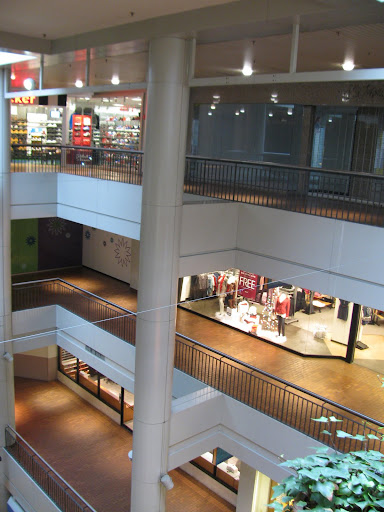
| Taken from the upper Kmart entrance to Gallery I. Vacancy and marginal stores rule the roost on the upper floors. The largest storefront--"How Philly Moves"--is a public mural studio. |
It was in 2006 that Macy's merged with the May Company (now, recall, Strawbridge's anchor). Initially, it seemed that Macy's would retain the Strawbridge's and thereby maintain the Gallery's east end; however, some random proviso or another managed to work its way in and Macy's wound up occupying the former Center City Lord & Taylor--an undersized (for it) space in the Wanamaker Building--instead. The full 520k square foot girth of Strawbridge's fell vacant.
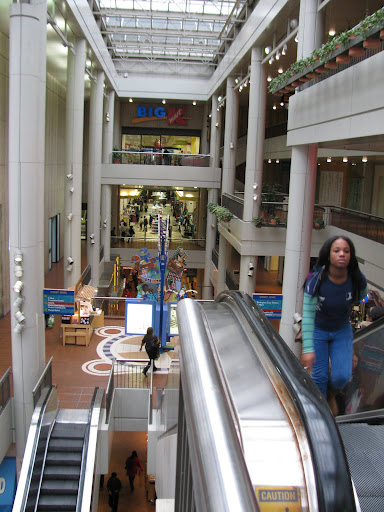
 |
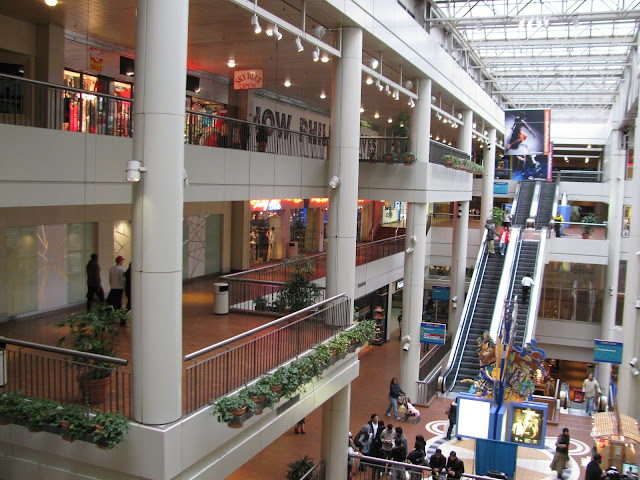
| The Strawbridge's atrium. The uppermost level would be the entrance into the floor now to be occupied by Philadelphia Media Holdings. The upper floors of this whole atrium are largely vacant, with just four open stores: Dr. Denim, Foot Locker, and a new Mural Arts visitor center on the top floor, and an orphan Wet Seal on the second floor. |
This was not the first Macy's Gallery near miss, either. Indeed, the first really major one* was when Stern's entered the Philadelphia market in 1986, by opening up a bunch of stores in former Gimbels locations (much as Boscov's attempted to enter the Maryland market exactly two decades later). During Stern's relatively brief tenure in the Philadelphia market, its parent company acquired Macy's', and over the next decade slowly merged operations together. (Stern's ceased existing in 2001.)
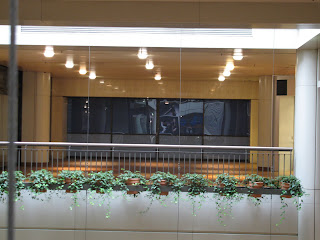 |
| An entrance never again to be used by retail. |
However, while Stern's, during 1988-9, decided to
leave the Philadelphia market, an opportunity was present--although never seized on--for Macy's, already established here through its acquisition of Bamberger's, to strengthen its own local market position by acquiring stores Stern's was vacating, e.g. at the Gallery, or for mall leasers to bring Macy's on. (Macy's did not go bankrupt until 1992; it emerged out of it mainly by merging with Federated in '94, one of whose nameplates was...Stern's.) They also had a chance in 1995-7 to locate in the then-former Clover, before it was leased by Kmart**; a plausible case can then be made that the third was when Penney's left, offering a large anchor position in Center City; this would make Macy's snubbing of the Strawbridge's space no less than the
fourth chance, and near miss, the Gallery had to bring them onboard.
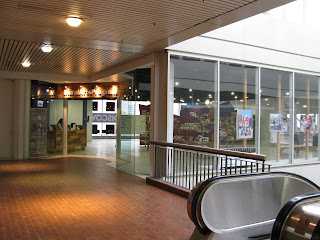 |
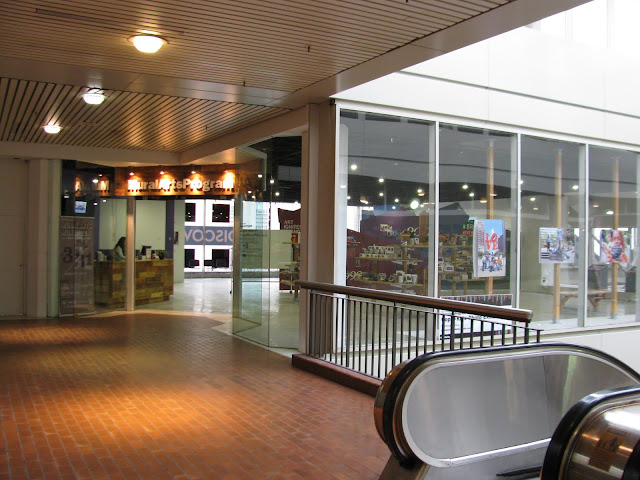
| The new Mural Arts visitor center/store--the lone new addition in this part of the Gallery. |
PREIT--by now, the Gallery's owner--responded first by trying to lure an uninterested Nordstrom. Nordstrom preferred Cherry Hill. Until 2007, in fact, nearly all national-level retail openings were outside the City proper, much less on Market East; the very urban-oriented recovery from the housing market crash is forcing reconsideration of store planning policies by those retailers who plan on surviving the recession***. Nevertheless--and despite the fact 2011 showed significant recovery, and 2012 is poised to, too--PREIT has not been able to find a retail tenant for Strawbridge's. Instead, it leased the top three floors of its ownership to the Commonwealth in 2007, and, what started this article, the third, and top concourse-accessed floor, to Philadephia Media Holdings, the parent company of the Inquirer, Daily News, and
Philly.com.
 |
| Vacancies around the former Strawbridge's. |
The master narrative of this move is that PMH wants to take part in Market East's "renaissance", spurred by the passage of a sign bill that allows more (and hopefully better) signs along this traditional retail center. Retail needs signs--always has. But, whatever the merits of the sign bill, it is not
in itself a cause of Market East's revitalization: there could very well be billboards atop vacant ground floors.
 |
| Too many vacancies to be good... |
No: it is an
instrument, and (hopefully) a fairly good one^. Furthermore, it is an instrument primarily created in order to usher along a renovation and (mid- to upmarket) repositioning of the Gallery, as well as the development of more large urban commercial and retail, particularly above the Gallery and on the south side. This will all take time.
 |
| The Wet Seal that is--unbelievably--still holding on. |
But PMH is
right in that there appears to have been some progress in improving Market East over the past year. SSH has presented exciting plans for
Girard Square, replacing the downtrodden tumorous toadstool sprouting out of what was once Snellenburg's with a large
DC USA-esque development anchored by a (rumored) Target. If this is indeed true, then what about the remaining portion of the former Strawbridge's space?
 |
| At the Gallery--we accept food stamps. Is there any better a symbol for hard times? |
Only three floors of Strawbridge's remain as leasable retail space: the basement, first, and second floor. These can be utilized in the same pattern as e.g. the Macy's in the former Jordan Marsh flagship, downtown Boston, or the generic three-story mall anchor, for that matter. The large size of the facility nevertheless allows it to be considered a "flagship" (Dillard's Norfolk flagship--a much younger store--has a comparable square footage to what's left), particularly when combined with the unique architectural class of the first-floor great hall, comparable with New York examples. All accounts agree that the bottom two (at the very least)
must remain in retail use, but conversion of the second story to office use greatly endangers further viability of the Gallery's Strawbridge's atrium's upper half. Three options present themselves for this redevelopment.
 |
| What is Walgreen's missing? A mall concourse entrance, of course! Also, that Walgreen's is really grubby and skuzzy inside--much like the Rite Aid by the subway station--and it occupies a choice spot for much more upmarket options, like casual dining. Repositioning the Gallery will likely involve kicking them out. |
- Conversion of the entire site into a single anchor.
- Conversion of part of the site into a main anchor, and the remainder into a sub-anchor.
- Conversion of the great hall into a mall sub-court, e.g. the Pavilion at King of Prussia, flanked by basement and second story sub-anchors.
For both (1) and (2) a dominant department store must be found. Primary options are Boscov's, now healthy and expanding again; Bon-Ton, assuming they capitalize on current macroeconomic dynamics; J.C. Penney, whose new CEO was the former Apple Store kingpin; Sears, with Bon-Ton's caveat; Kohl's, which has no mall anchor stores in the Philadelphia market, or even penetration in the Center City market; Century 21, although its merchandising style (roughly equivalent to Daffy's and on-way-out Filene's Basement may not make it amenible to being a keystone in a strong branding strategy; and (less likely) Bloomingdale's or Lord & Taylor, both of who would likely favor space west of Broad (if available), or Dillard's or Belk, neither of whom have so far entered or even expressed interest in the Philadelphia market. Secondary anchors include Daffy's, T.J. Maxx, Marshall's, Kohl's (in its current Philadelphia-market format), Toys "R" Us, and any big-box anchor in the 50k sf range one can name. (Furniture showrooms are popular at the Pavilion).
 |
| The Black Friday view from higher in the post--today. |
Option (3) includes the secondary anchors, and adds inverted inline through Strawbridge's main hall, possibly bounded by another secondary anchor. This formation, however, relegates anchorage to the Mellon Independence Center's retail--essentially, the Ross. (A later post hopefully treats this). It also loses the largest potential salable space in Center City--even if you were to empty out all the inline shops in the Shops at Liberty Place (again, later post) and replace them with a full-scale full-line department store, the total retail space would
still be smaller (although perfect for a higher-end anchor, like Bloomingdale's or Neiman Marcus). It loses, in other words, one of the best department store sites in the City.
 |
| Mural Arts installs one of the first major examples of large signage on Market East. Another is 801 Market's leasing signs. Are any ads up on 1234 Market? |
For these reasons, I favor attempting Options (1) and (2) before attempting (3); (3) is, in some ways, a sign of defeat. To me, the best option would be bringing Boscov's to the
entire space, which is now down to a large full-line department store in size; with the Strawbridge's building fully occupied and Girard Square built, development attention would then focus on 800 Market (the original Gimbels, aka the Disney Hole) and 1301 Market. It may take some time for this--the Manhattan Mall is useful as a case study. For nearly a
decade, from 2001 (when Stern's was folded into Macy's), to 2009 (when J.C. Penney moved in), the Manhattan Mall's primary anchor space lay vacant. And this was in New York--just off Herald Square, where Macy's flagship is!
 |
| This three-level skybridge links the Strawbridge's building with a large parking garage (facing Arch). It was originally built for both Strawbridge's and Lit's. Nowadays--assuming they are open at all--the top level enters the State offices, and next summer the middle level will link into the Inky offices. This will leave just the lower level to be linked into the retail mall. (As an aside, the former Lit's entrances all likely link into either hallways or office suites--if they are open at all.) |
The Gallery could also stand to reposition its upper floors. For one thing, the current food court, down in the basement, is badly placed. Moving the food court to the top of the complex, and giving the dining area(s) great big south-facing windows would be a wise idea. With the conversion of Strawbridge's third floor to office space--why not put this in the top floor of the atrium at its concourse entrance?
 |
| Underutilized space in the Reading Terminal Headhouse. |
The other major underutilized features are the parking garage entrances. One exists for each half of the Gallery, and the entrance to each is next to the west anchor. Gallery II's also features a rather serpentine pathway linking it with the concourse while bypassing said anchor (originally Penney's, now Burlington Coat Factory). This is a
very odd layout by any standard; it would be much better to have the west parking garage skybridge entrance directly access the anchor instead, and utilize the serpentine corridor connecting the garage with the main concourse for either (a) an inline store (taking advantage of the available view, perhaps?), or (b) an anchor extension, possibly in terms of an in-store café or related amenity.
 |
| Bland blank walls fill this lower atrium. A service door, out of sight left, may be all that's left of a former subway access path. |
Finally, we have to consider the third level of the former Gimbels anchor and its relation to Gallery II's uppermost floor. Between Stern's and Clover's usage of the space, the top three floors were all converted to office use; the only tenant there today is a large methadone clinic occupying the topmost floor and half the fourth. The third is entirely vacant. Part of the leasing problem likely arises from two facts: (1) The upper three floors were converted from retail to office use ca. 1990, and seem to have been untouched since, and (2) the property is the sole
Vornado property in the city. Vornado, being a New York firm, is likely trying to market this property at New York or Boston-type rent levels--no wonder, then, it is in a state of perpetual vacancy!
 |
| The Market East Station entrance from the Headhouse atrium appears to be the least-utilized of the three, despite its also being the cleanest, in an atrium surrounded by blank walls rather than commercial offerings. |
901 Market (confusingly, both this building and the Gallery bear the address
901 Market) has a basement and five floors. With a strong Gallery, two anchors could be stacked on one another (an semi-example would be the way the Nordstrom in
Westfield San Francisco is stacked on top of inline stores) or perhaps Westfield's own solution. Another key to this structure is how the fifth floor is used--this is the space currently filled by the methadone clinic (a very marginal use, by the way); it could be offices (Gallery offices? doctors' offices?), storage, a third floor of an upper anchor (either paired with a lower anchor, or with the current anchor floors converted to inline mall space, preferably with a new atrium hollowed out)--but all this assumes a retail conversion of the top half of the structure. What if an office tenant is found instead?
 |
| A strange door. An old subway entrance? The Reading certainly once would have maintained a subway entrance to its station. One possibility to pursue would be (re)connecting it to the subway concourse, and enlivening the concourse along with the atrium. In the long term, closing the 11th and 13th street subway platforms and opening a new one at 12th needs to be considered (keeping the free transfer to the trolley platform open, of course); this would also strengthen what is a quiet little nook. |
Enter Plan B. Finding an anchor, or anchor series, for the top half of that structure would strengthen Gallery II's top floor's position vis-à-vis inline retail; if none is forthcoming, however, the inline option should just be abandoned and the whole top floor converted to either a big-box sub-anchor or perhaps office space with an atrium view. This may be done by preserving the parking garage connection already discussed, and having it used to access the sub-anchor directly; office space conversion of the top level should also come with a sealing-off of the west anchor's topmost mall concourse entrance. (Office conversion should also make use of the built-in lobby space for the as-yet-unbuilt tower.) In
all cases, however, having a direct entrance from the parking garage to the west anchor (currently Burlington Coat Factory) remains--or seems to--a good idea.
 |
| Closeup of the sign. |
Final Gallery thoughts. The narrow serpentine mall corridor that parallels 10th St. should be eliminated; the newstand and, er, jewelry store along it moved to elsewhere in the mall. The corner parcel(s) so created can then be marketed to a casual diners: casual, chain eateries, particularly those with al fresco seating would have the triple purposes of (a) enlivening the Market Street streetscape, (b) catering to tourists' taste buds, and (c) encouraging people (tourists) to tarry (and therefore spend money at the Gallery). Halfway down the block, however, a new grand midblock entrance to Gallery II from Market should be called for; this will necessitate the closure of the Gallery II Payless as well as (probably) the wig shop above it. And if the Gallery is to be successful, it
must link with the Marriot, Reading Terminal Market, and Convention Center in the Headhouse in such a way as to strengthen the links between all three--the opposite of the case today.
 |
| The Field House bar presents a certain quandry. For positives, it is an active use in an otherwise relatively moribund Headhouse; but for negatives, its space would be much better used bringing the Reading Terminal Market to the Convention Center and Gallery. The Headhouse could be a gate, a unique connector; today, it dispels everything from it at least as much as it connects. |
Moving west to the Reading Headhouse, we have the problem of an underutilized and devoid space. The Headhouse is characterized by a large atrium, with each of its levels offering front-door access to major Market East features: the basement for Market East Station, basement and ground floors for the Gallery (ground via the concourse behind the Aramark Building lobby), ground floor for the Reading Terminal Market, and second floor for the Convention Center and Marriot hotel. But this atrium does not
knit these attractions together, as it should; instead, poor design decisions and lethargic leasing actually
repel them somewhat. Wayfinding is a bit of a problem; however, the key move to be made is
to bring the Terminal into the Headhouse.
 |
| The current passage between the Headhouse and the Reading Terminal Market. A walk of pure boredom, followed by dodging traffic on Filbert. Certainly not a very inviting entrance to one of Center City's great destinations! |
This would be done by a very simple move: move the Field House to wherever they so please, and open their space up as an expansion of the space-strapped Terminal. This would net them as much space as their current expansion project. (Closure of the 1100 block of Filbert may well also be desirable.) And let the Terminal Market flow down into the atrium and out the front door--perhaps as rotating display installations, punctuated by a weekly farmer's market (inside in the winter and inclement weather, outside otherwise). Such displays could be flowers for the Flower Show; buggies for the Car Show; festive Advent and
Christkindl Nacht displays for the holidays; and so forth. Possibly even move key Terminal Market institutions into spaces surrounding the atrium. In other words, the Headhouse becomes the front door for the Terminal Market, which picks up the slack generated by the fact that none of the other institutions' front doors are in this building. It also better publicizes the Terminal Market and makes it effectively a Gallery anchor.
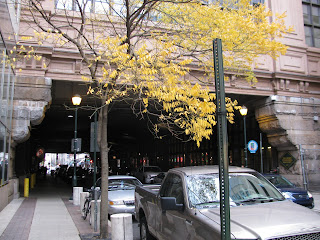 |
| How much traffic does Filbert get here? Closure of the street and making the Reading Terminal Market one continuous facility may not be a bad move. A Market that extends from the Headhouse atrium to Arch would be larger and able to handle more stalls; it would also be more visible from Market, especially if it's allowed to spill out from the building. |
Been talking too long. (
This post took me four days to write!) I'll stop yapping now.
 |
| Filbert behind the Gallery. No fewer than three large parking garages, and a very low-slung bus terminal. Moving the bus terminal to a space off of the Gallery's service drive was an idea kicked around in the most recent Market East plan, filled with generally good ideas despite (or perhaps because of?) its being kludged together when Foxwoods-to-the-Gallery seemed imminent. If this is done, however, access to the bus bays from likely waiting areas becomes a major problem. On the plus side, it also opens up land the current depot sits on for development. |
____________
* Stern's seems to have snapped the Gimbels lease right up.
** Had this happened, it is likely that the former Gimbels (whose retail space was curtailed to its bottom three floors, two of which were occupied by Clover and later Kmart, ca. 1990) would have either (a) been converted into a Men's or Furniture store (there are examples of both), or (b) lain vacant much as Strawbridge's has for the past five years.
*** This also makes Bon-Ton's shedding of its (historic) Carson's and Younker's downtown locations seem
particularly short-sighted. Bon-Ton did develop a bad habit of vacating the downtown stores it acquired, starting(?) with Allentown's Hess's.
^ Which is partly why I helped found, and continue to maintain, the
Concerned Citizens for Market East. The sign bill offered a useful instrument for reinvestment, and the policy line being held by
SCRUB was definitely
not going to do the job. Indeed, over the past two years they had made themselves look silly by protesting what was entirely reasonable large signage at 1234 Market and on the Thomas Lofts' party wall.