Showing posts with label Rail Rhode Island. Show all posts

Monday, February 10, 2014

Realigning Providence

Note: This post supersedes Providence Alignments (PA) and part of Regional Rail from Providence, East (RRPE). Both will be referred to in the text, however.

Having developed a high-quality regional rail network focused on Providence, we find ourselves in a bit of a pickle. Figure 1 shows what it is.
Fig. 1. Diagram of ultimate RRI operations + MBTA P.L. under current track alignments
The problem is that, under current conditions, the whole network is highly unbalanced; of the four lines (plus one branch each) and the MBTA Providence Line (P.L.), fully 80% approach Providence Station from the east. Figure 2 shows what we want instead. Specifically, we want the Blackstone Valley Line to approach Providence from the west. That way, it can feed into the Mount Hope Bay Line (cf. RRPE), thereby forming an X-frame S-Bahn-esque structure.
Fig. 2. Desired RRI +MBTA P.L. operations.
To do this, however, we'll have to take a new look at central Providence. Figure 3 shows Providence Station's current and attainable alignments, unchanged from PA Fig. 9.
Fig. 3. PA core network (Fig. 9 there)
But to bring the Blackstone Valley Line in from the west, we need an entirely new station approach, and that implies an entirely new station; using Union Station as our template (Figure 4) would continue to yield an eastern--rather than western--approach for that line.
Fig. 4. Providence Union Station
The historic alignment suggests that the least disruptive path, Figure 5, would be to recurve on the old Union Station alignment, forming, essentially, a tight wye. This would undoubtedly require the demolition of One Citizens Plaza and/or the partial culverting of the Mossashuck at its mouth. It also requires a new Providence Station facility along Main Street between Steeple Street and Throop Alley. However, the curvature required for this alignment is ... problematic ... to say the least. And One Citizens Plaza (Figure 6) presents its own problems.
Fig. 5. Tight curve
A better alignment is available, however. Thanks to highway engineers, (Figure 7) we have decent, if still tight, curvature from Memorial Drive to the I-95 alignment. Continue on it a short way (about a thousand feet) and you can recurve back onto the existing alignment. And with this curve, we can bring Union Station back into play, instead of needing a new facility in tight confines.
Fig. 6. Like a giant middle finger sticking into the air
At this point, the existing Providence Station is outmoded, and so too are the central Providence discussions in PA and RRPE. There is no way to make it from the 95 alignment onto its west approach--the curvature is just too tight. And because it is outmoded, once the replacement is built, the old facilities can be closed, subdivided, and resold.
Fig. 7. I-95 alignment
A Headache

The biggest problem, however, is that of rethreading a reasonable facsimile of the old New Haven alignment through from I-95 to the East Side Rail Tunnel portal. While some of it is easy--there's a fairly clear station box from the Courtyard to the Woonasquatucket--much of it is difficult.

Chief among the difficulties are (a) those of weaving a rail line through the I-95/US-6/Memorial Drive interchange, and (b) dealing with One Citizens Plaza.
Fig. 8. Weaving a rail alignment into Providence's core
First of all, however, we'll note that (c) that the East Side Tunnel portal has what appears to be +15' elevation with respect to Main Street. While we could undercut the tunnel's west approach and the westernmost part of the tunnel itself, the least expensive option requires utilizing as much of the old rail grade as is salvageable. As there is no room to grade a -30' difference (to -15' elevation with respect to Canal Street)--that would require 3,000' at a 1% ruling grade--and hence have a sunken station box and low bridge, and as route utilization mandates grade separation, we'll assume that the station box is at the historic Union Station level, i.e. +15' relative to Exchange Street. This drives elevation*.

This means that the solution to (b) is to route the station's east approach through One Citizens Plaza's south, well, plaza. In place of the plaza, a lobby extension and/or other use would front the Woonasquatucket-Moshassuck confluence; minor takings would be required for the necessary curvature to return to the original alignment. (Unfortunately, those buildings are obviously historic, but since some idiot went and built an office building right in the middle of the old alignment, you're kind of stuck between a rock and a hard place.) This section would be built on a trestle in order to encourage integration of "ground rights" under it by adjacent owners.
Fig. 9. New rail alignments in Providence's core
For (a), this drives the elevation of the trestle over the intersection of Memorial and Francis; the trestle's existence also has the handy side effect of forcibly road-dieting what is, by all appearances, a fairly ugly stroad. Further on, several interchange flyovers would need to be regraded and rebuilt as the railroad curves onto an embankment and heads down a 1.6% grade to make a 30' elevation change in 1900'. (Use Figures 8 and 9, and this file to help understand how the rebuilt grade is integrated into existing infrastructure.)**

Our final consideration is the station plant itself. We renovate and reopen the old Union Station waiting room and ticket offices, as well as provide a sheltered concourse in the old underpass; secondary platform accesses are on Exchange Street. The box, trestled, allows for active uses under it; the smallish, redundant greenspace cater-corner to Burnside Park--a beautiful common--would be eliminated in favor of TOD, as would the larger, also-redundant greenspace between the current Providence Station, Providence Place mall, and the State House greensward. (Among other things, development would better frame the State House along Francis St.)
_____________
*Much to my chagrin. I really wanted it to be sunken.
**One elegant solution would be to rebuild the interchange as one large surface roundabout, with routes feeding into it from US-6, I-95, and Memorial Drive.

Monday, February 3, 2014

Rail Rhode Island

Where we last left off, we discussed the infrastructural challenges associated with bring regional rail to southeastern Rhode Island. This was precipitated by a consideration of Providence alignments.
New Haven map of Boston and Providence rail networks
Now I'd like to come full circle, and pare the New Haven alignments maps down to a good state network for Rhode Island.
New Haven alignments from Providence
Why a state network?

Rhode Island is perhaps unique in a couple of core attributes. First, it is dominated by a single city, Providence. This in itself is not unique. But second, it is such a size that the state is very nearly ringed by natural destinations--and a system serving these destinations would have approximately the same dimensions as a typical commuter rail system. That is, what makes Rhode Island unique, from a transportation planning standpoint, is that its state needs are fulfilled by what is essentially a large commuter system.
Natural destinations from Providence--cities and places surrounding, but not far, from Rhode Island. At right, Cape Cod.
The actual commuter elements are concentrated in a far smaller part of the network: to Bristol, to Fall River, to Woonsocket, to Kingston, to Mansfield, to West Warwick. The greater system is built on a series of "Lancaster Model" regional links.

The Lancaster Model

Consider the city of Lancaster, PA. It is a small city of only about 60k--a third of Providence's. It is linked, however, to Harrisburg, Philadelphia, and New York with regular (almost hourly) trains. And this regularity drives ridership both to the east and west. So, despite Lancaster and Harrisburg's small sizes--the latter is 50k--regular service drives outsize ridership.

Actually, what makes Lancaster a useful model is that, globally, it is typical. A midsize city with good rail service realizes good ridership, much better than what most American examples have been capable of. The small cities along the Empire Corridor--Rochester, Syracuse, Schenectady, Utica, Albany--likewise realize outsize ridership. So do the smaller cities on the San Joaquin in California. And so do New Haven and New London. So an optimal regional model strings services between these cities.

This, in turn, allows us to see natural termini at
  • Worcester
  • Framingham
  • Putnam
  • Norwich
  • New London
  • Newport
  • New Bedford
  • Boston
  • Cape Cod
in addition to the tighter belt of commuter services.
Rail Rhode Island
And from New Haven lines from Providence to these natural termini flows this nine-line network. From northwest counterclockwise:
  1. Blackstone Line. Service to Worcester via Woonsocket and the Blackstone Valley.
  2. New York-New England Line. Splits from Blackstone Line at Blackstone; heads to Putnam via its eponymous right-of-way.
  3. Thames River Line. Follows the old New York-New England Providence branch to Plainfield, and the Thames Valley subdivision (New London-Worcester) from there down to Norwich. It would be reduced back to Plainfield in the presence of Connecticut regional rail.
  4. Mystic Line. Follows the Northeast Corridor to Waverly; there meets Shore Line East trains. (Extension of the latter is already on the drawing boards.)
  5. Narragansett Bay Line. Dubbed "Bristol-Newport Line" last post, renamed after the bay it runs alongside.
  6. Mount Hope Bay Line. Formerly dubbed "Fall River-New Bedford Line", likewise renamed after a bay it passes.
  7. Cape Cod Line. Extends from Providence to Middleborough via Attleboro and Taunton. Formerly route of the Cape Codder. You may note it doesn't actually reach the Cape; more on this later.
  8. Providence Line. Existing MBTA alignment along Northeast Corridor.
  9. Patriot Line. Service to Framingham via Foxborough. Named for the fact it passes Gillette Stadium.
Services on these lines would run hourly, while services from the commuter termini run fifteen minutes.

What's the Deal with Cape Cod, Anyway?

Cape Cod is a resort area, and a bit different than the type of service Rail Rhode Island is geared to offer. In fact, service to the Cape mainly needs to target weekenders, with vacationers and Cape denizens both being secondary categories. For this reason, peak service needs to be Friday-Sunday, rather than the workweek core of the commuter networks feeding into the Cape. And because a weekending population is less transfer-sensitive, it makes sense to run (or franchise) service from Middleborough on separately. (That said, a good connection is still self-evidently necessary.)
Cape Cod route/franchise
An Operations Agency

While Rail Rhode Island by itself is essentially built to offer service indistinguishable from other commuter/regional rail services in the United States and abroad, it does also have the potential to connect into a broader regional network. Most of New England can, in fact, be united by such a network. So a further avenue of exploration of development of a larger New England rail network, which large chunks of proposed Rail Rhode Island would be subsumed into.

A Providence Pickle

Providence has a bit of a pickle. Its track alignment only allows for through-running from all other lines onto either the Mystic or Thames Valley lines. This is untenable. Among other considerations, the Blackstone Valley and Mount Hope Bay Lines have, between them, the highest ridership potential; a through-routing for them must be found. Expect further discussion on this matter soon.

Monday, January 27, 2014

Regional Rail from Providence, East

Providence Union Station--back in the day
Alon Levy has kindly pointed out to me that none of the bypasses of the Providence curve really make sense for the stated purpose in the last post; time savings are minimal relative to expense for all of them. (That said, I maintain that the New Haven freight bypass alignment would be an all-around superior route had Union Station trackwork not been removed and erased in the 1970s. It is true, however, that there were excellent urban planning reasons to do something with the existing alignment--it's just that rail access was not considered a a high planning priority.)
New Haven in eastern MA and RI
Even so, the East Side Tunnel continues to have regional use. It is by far the best access alignment from Providence to cities to the southeast--Newport, Bristol, Fall River, and New Bedford. Indeed, it was historically used to provide commuter service from Providence to those latter two cities.
Slade's Ferry Bridge--a lost asset
While the closure and demolition of the Slade's Ferry Bridge severed the link between Providence and Fall River and thence Newport, it does not appear that the New Haven ever actually linked the route from Fall River to New Bedford with its line from Myricks to Newport. Figure 1 shows commuter rail to southeastern Rhode Island using only former New Haven lines.
Fig. 1. Historical NH alignments from Providence SE.
A Circular Argument

Follow the alignments, however, and you'll notice a pattern. Two major alignments historically linked Providence and Newport; they diverged at Fall River. One route linked to the Bristol branch at Warren; the other route ran up to Taunton and around via Attleboro back to Providence. Both are highly inferior alignments today. The implication is that any workable commuter rail from Providence southeast, which hits the four natural termini, must of necessity deal with the region's challenging topography--specifically its strewn-about fjordlike bays.
Mount Hope Bay
Of particular interest is the Mount Hope Bay, whose head is the Taunton River estuary up by Fall River, and mouth flows into the Narragansett Bay just south of Bristol, at the conveniently-named Bristol Point. New Haven easements are available all around Mount Hope Bay, but none provide a good crossing of Mount Hope Bay.
Fig. 2. Hypothetical single crossing of Mt. Hope Bay, superimposed on existing or available rail easements in the area. Reasons against further pursuit--long high bridge requiring access lines to New Bedford (right), Newport (bottom), and Fall River, as well as an excessive greenfield alignment cf. a two-crossing approach--are self-evident. Nearly every other potential single crossing of the bay yields the same, inferior, results.
The bay also demands two crossings. While a single crossing through its middle would theoretically be superior, such a crossing would (a) happen at its widest extent, requiring more than double the superstructure required by crossings at its head and mouth, (b) demand construction of lengthy new alignments to the crossing, and (c) induce excessive branching, needing no less than four different lines to reach each terminus. By contrast, the two-crossing approach allows for two lines--Bristol and Newport would be served by the same line, and Fall River and New Bedford the other.

Across the Taunton

Let us first turn our attention to the Fall River-New Bedford line (FRNB for short). This route is the unification of three discrete routes:
  1. The Somerset Branch, a trace alignment the New Haven abandoned at least prior to 1948. This alignment is salvageable from the junction with the Bristol Branch east to the Lee River crossing, just beyond which the Brayton Point power plant has obliterated the ROW*. This route used to extend across Slade's Ferry Bridge into Fall River.
  2. A Taunton River crossing.
  3. The Watuppa Branch, a good-quality easement from the former mills at the head of the Quequechan to New Bedford.
As good easements are available both east and west of the crossing, most of the time needs to be focused on the crossing itself. As it stands, there are two possible crossing routes:
  • The I-195 alignment across the Braga Bridge and under Falls River
  • The Slade's Ferry alignment with a new alignment built up the Quequechan's remnants to the Watuppa Branch.
These are shown in Figure 3, below. Note that the I-195 alignment, in green, is a good mile less than the Slade's Ferry alignment--thereby optimizing the former.
Fig. 3. Links across the Taunton. In red: the Slade's Ferry alignment that "more-or-less" shadows what's left of the NH alignment; in green, a more direct alignment up the I-195 corridor. Notice how green is dramatically shorter.
Over Bristol Point

The other connection needing to be made is the on the Bristol-Newport line (BN for short, heh). This line has been assembled together for the following three reasons:
  1. Remember what we said about a single-bridge alignment and excessive branching?
  2. A Taunton crossing following the I-195 alignment will by necessity make a cutoff down to the old NH alignment extremely difficult, and furthermore, impinge on potential station sites. No, it is better here to have the station to Boston riverside, and the one to Providence downtown.
  3. As previously stated, a Providence-Fall River-Newport alignment is relatively circuitous. If we want to optimize for straightness (and stay of out Massachusetts), we want a Providence-Bristol-Newport alignment.
Such a line demands a crossing of the Mount Hope Bay by Bristol Point.

On the Aquidneck Island (Newport) side of the bay, this is easy. The NH alignment closely parallels the shore, and the geography allows for a gentle turn onto a bay crossing. Any ramp up can be built alongside the existing alignment.

Far harder is the Bristol Peninsula. The former NH alignment there ran water level as well, but ended in downtown Bristol. Extending from it would require carving out a new waterfront easement, as well as raising track level to the clearance required across Mount Hope Bay.

Far better is a power alignment heading straight down the center of the peninsula. This alignment only extends as far south as Gooding Avenue, however. Extending it further requires cutting through a smallish park and following metes-and-bounds boundaries to minimize takings; it is possible to continue the alignment without significant disruption until between State and Franklin Streets.

At State, entering into a section of town becomes unavoidable; even with an alignment designed to run behind street lots, properties will have to be taken at the cross streets. At Mount Hope Avenue, the optimal easement course curves across Dewolf Avenue through a couple of largish empty lots to run behind Antony Avenue. This, among other things, brings it across the buildup border at Woodlawn Avenue in the woods south of Wolf Cemetery. The proposed route then curves along Metacom Avenue and Ferry Road, alongside Roger Williams University, as it prepares to cross Mount Hope Bay.

Finally, a note: Accessing the power line easement from the Somerset branch in Warren will almost certainly require construction over a fairly large cemetery.

The new Bristol train station would be sited at Franklin Street, where some light industry would be redeveloped into TOD. Indeed, this whole route parallels an extended section of light industry on the east side of Bristol. This may be of use in developing lineside customers.
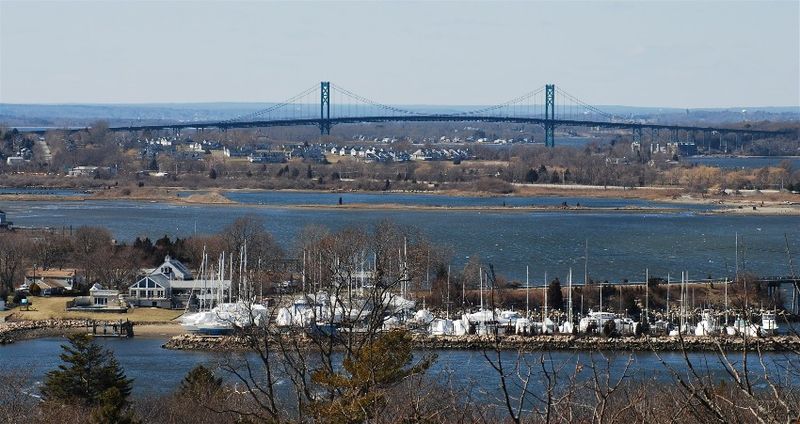
Mount Hope Bridge
Crossing the bay itself could be done with either (a) a new crossing, or (b) a retrofit of the Mount Hope bridge. For (b) to happen, minor takings of curvature in Bristol Ferry would have to occur, but far more significant would be essentially rebuilding the entire span to significantly heavier loads (not freight-heavy, though) and to have two decks. The current bridge's approach viaducts are rather...spindly...as it is.

Actually, due to the relative age of the current bridge (while the structure is pretty, several obvious deficiencies make it a poster child for functional obsolescence), a multimodal reconstruction may well be called for. Figure 4 below shows how a new alignment through Bristol would work with the existing ones.
Fig. 4. Mount Hope Bay crossing and a new alignment through Bristol, up to Warren.
Into Providence

Two potential alignments could be made into central Providence from the East Side Railroad Tunnel. The first is Option D, as I described the other day as
...link[ing] Providence Station with the old East Side line. Unlike Option C, it does so far closer to the city, linking a short bore tunnel under the Moshassuck and part of College Hill with the existing East Side Railroad Tunnel and running across the Crook Point Bridge.
and the second is Alon Levy's countersuggestion that
for Providence-centric regional rail, it would be interesting to demolish either One Citizens Plaza or the buildings at the northeast corner of Steeple and Canal and go elevated over either Memorial or Kennedy Plaza).
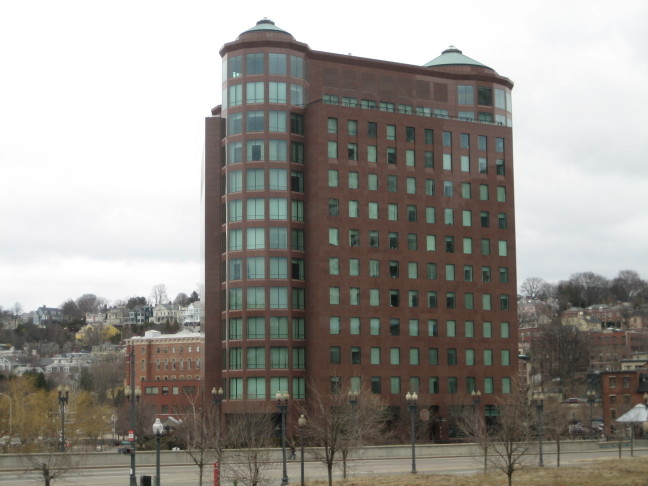
One Citizens Plaza
(I would note that we may not necessarily need to demolish One Citizens Plaza so much as reorient it to Moshassuck Place; the small plaza between the building and the street appears to be sufficient to hold a two-track elevated facility. It's pretty much built over the old NH alignment as it is.)

While either way works, I am of the opinion that the short (~4400 feet or 1.4 km) cutoff tunnel to the existing station works better in a larger picture. S-Bahn networks, in particular, like to cluster at the core. That said, since Alon's alignment is a reflection of the NH one, and the railroad also had an alignment up the Seekonk--one still in use today--a network built around a new station over Memorial Drive at Union Station is very much practicable as well. Figure 5 shows how the bored (red) and elevated (black) alignments interact with the existing one (blue).
Fig. 5. Tunneled (red) and elevated (black) approaches to DT Providence from the East Side Tunnel (blue).
The Whole Picture 

Having found the existing easements out of Providence southeast, and analyzed the infrastructural challenges required in turning them into a line (or two), we now have the beginnings of a high-quality statewide network centered in Providence. These southeastern routes are infrastructurally the most challenging; we'll look at other routes later. For now, our final result is Figure 6.
Fig. 6. Regional rail from Providence southeast
___________________
*Note that, with Brayton Point's planned 2017 shutdown, opportunity may be had to re-establish the ROW. This would greatly ease curvature from the Somerset Branch onto the I-195 alignment.

Friday, January 24, 2014

Providence Alignments

Of all the cities served by the Northeast Corridor (NEC), Providence has the most severe alignment problem.
Providence Station: Inadequate for the purpose
Providence's current alignment is relatively new. It was installed in the 1980s, to reach a new train station replacing one being decommissioned. It is also, in every way, objectively inferior to the alignment it replaced. There are two major deficiencies associated with this alignment: (1) excessively sharp curvature in the station approach, and (2) undersized station facilities. Figure 1 shows the current alignment (in red) and the old New Haven (NH) alignment, where divergent from the modern one (in purple).
Figure 1: NEC and NH legacy alignment
Figure 2 shows the difference in curvature between the modern and historical alignments.
Figure 2: NEC and NH alignments in DT Providence
From these figures we can ascertain characteristics of the two alignments. The original NH alignment bypassed Providence city--still in use--to reach its main train station, along Exchange Terrace. There, it crossed the Woonasquatucket and Moshassuck Rivers just above their confluence into the Providence River, and diverged. One route headed north to Pawtucket, where it split into routes to Woonsocket and Attleboro. The other crossed Main and Canal streets, and ran through the East Side railroad tunnel, across the Crook Point bridge, and through Rumford and North Seekonk, returning to the NH mainline south of Attleboro. This latter route was built as a freight bypass, but it also proved an important commuter connection from Providence to Bristol and Fall River. The NEC, meanwhile, follows the old NH (originally: Boston & Providence) mainline north to Pawtucket and then east to Attleboro.
Providence Union Station: Adequately sized, unusable
Providence Station, meanwhile, was built to replace Union Station in the mid-1980s. While it improves on the curvature characteristics viz. the old NH mainline, it appears that planners never considered the superior track geometry the old freight bypass offers. Furthermore, the station was built to handle rail traffic at its nadir, and as traffic is increasing, the station is reaching capacity. Indeed, were Providence to have a fully built-out commuter rail network--one possibility is shown as Figure 3--the station would be utterly incapable of handling the demand load. Worse, its predecessor--although still in place--has seen irreparable damage against any possible return of the railroad. The ROW is unusable between I-95 and Canal Street.
Figure 3. Providence commuter rail possibility.
So we now turn our attention to what it would take to actually introduce heavy infrastructure so as to solve these stated problems. Looking to implement low-curvature routes, three options present themselves--each would have its own station facilities. None are cheap.
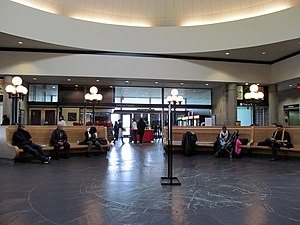
The waiting room is a bit...small...for a major NEC station
To see the maps I generated for this post, see linked here and here.

The Options
Figure 4. Option A: Providence-state line tunnel
Figure 4 shows Option A. This option parallels the existing NEC, but eases curvature through the construction of a cut-and-cover tunnel under US 1 to Pawtucket, and along Cottage Ave. thence to the state line. Almost incidentally, it eases the moderate curvature around Pawtucket. The diagram shows some curvature around the Blackstone crossing, as it's assumed to follow existing easements wherever available; a deep bore nullifies that.

However, this is a lengthy tunnel--the distance from downtown Providence to the state line is about the same as the length of the Philadelphia tunnel proposal I demolished at length some time ago. And while Providence's infrastructural need is greater than Philadelphia's, one look at the old NH freight bypass suggests it's not that much greater.
Figure 5. Option B: Providence River tunnel
Figure 5 shows Option B. This was the first option that drew my eye on the map--the idea is to eliminate the station curve entirely, something none of the other options do. Unlike Option A, the tunnel is of moderate length.

But also unlike any other option, this one suffers from multiple shortfalls. First, it's the only option with extensive sub-water-table tunneling. The alignment is quite literally waterside. Unlike any other alignment, an entirely new intercity station site must be built--and the best place looks to be quite literally under the confluence of the Woonasquatucket and Moshassuck rivers into the Providence. Part of this alignment lies under semi-active port facilities. And finally, this alignment has a sharp curve that just will not go away. It offers no time savings over the existing Providence bypass.
Figure 6. Option C: New East Side tunnel
Figure 6 shows Option C. This alignment would run a new deep-bore tunnel under the East Side and link up with the old NH freight bypass--with excellent track geometry--in East Providence. Its curvature, while constant, is also gentle, and it has far less length, and hence cost, associated with it than Option A.

It is still, however, a deep bore tunnel.
Figure 7. Option D: "Option-C-cheap"
Figure 7 shows Option D, or perhaps "Option-C-cheap". Like Option C, it links Providence Station with the old East Side line. Unlike Option C, it does so far closer to the city, linking a short bore tunnel under the Moshassuck and part of College Hill with the existing East Side Railroad Tunnel and running across the Crook Point Bridge.

However, in some ways this proposal reeks of a penny-wise, pound-foolish attitude. Not only does it itself have the sharpest curve of all the proposals, despite its brevity, it also fails to ameliorate the lone sharp curve on the NH alignment--at Crook Point. It is perhaps better suited to regional rail than true HSR.
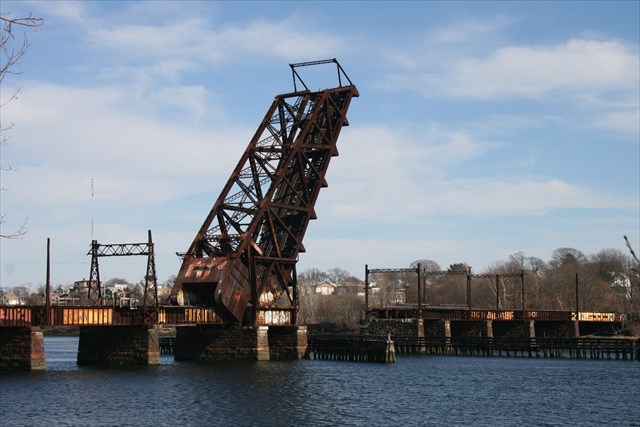
Crook Point bascule bridge, abandoned 1976
Finally, please note Figure 8 below, with all four options superimposed on the legacy alignments, to give one a sense of how each of these stack up against each other.
Figure 8. All four proposals to the same scale.
Ranking the Options

Ranking is somewhat subjective, but my primary criteria, in order of importance, are
  • Cost
  • Length
  • Curvature
As all of these proposals involve a new platform level (at the very least), we can assume that cost is fixed. What we are therefore looking at is thus cost per unit length of tunnel. Of these, Option A is (probably) the least expensive, and Option B (definitely) the most expensive. But looking at the criteria, we find
  • Option A. Cost: -. Length: -. Curvature: +
  • Option B. Cost: -. Length: +. Curvature: -
  • Option C. Cost: +. Length: +. Curvature: +
  • Option D. Cost: +. Length: +. Curvature: -
Option C clearly wins out--but it is not quite the most incrementalist approach available.  
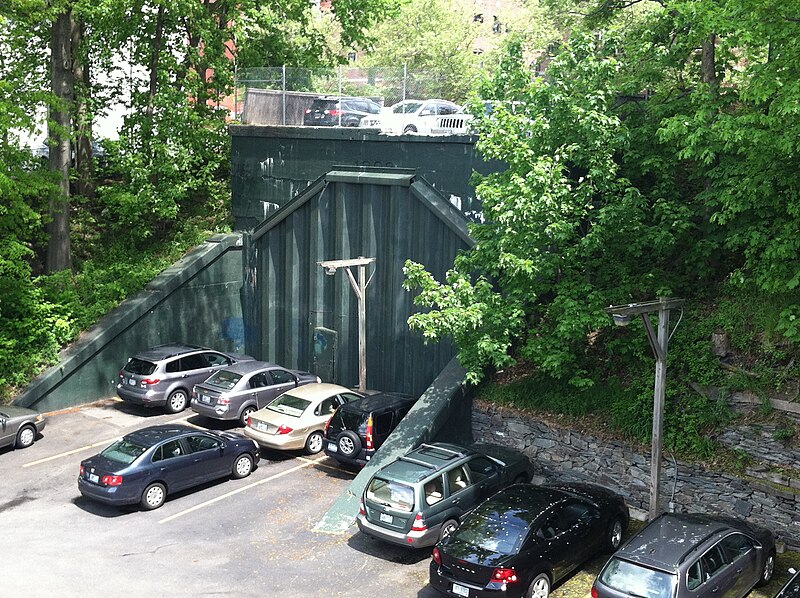
East Side Railroad Tunnel--West Portal
That would be to start with Option D, implementing Option C as and when further funds become available--perhaps as part of a package dedicated to fixing Along the Shore's significant curvature issues in Connecticut. In the meantime, Option D offers expanded station facilities, a better Amtrak alignment, and a platform to develop better--and perhaps, eventually, comprehensive--Rhode Island rail service.
New Haven operations in MA and RI
A look at the core of Figure 3's schematic--Figure 9--displays this, with the East Side line and Option D linked up to create an S-Bahn-esque core.
Figure 9. Figure 3's core network
Conclusion

Ultimately, while Providence's future is its own, what the New Haven left behind was a framework of easements that can provide it with excellent commuter rail. And what the Northeast Corridor needs today is HSR geometry. Hopefully we can do the right, the incremental thing--reactivating the substantial underutilized/disused infrastructure, while judiciously inserting HSR infrastructure where needed. This needs Organisation vor Elektronik vor Beton to happen, though--not the Beton-first mindset our transit agencies always seem to have.