Or: A Problem That's Not Really A Problem
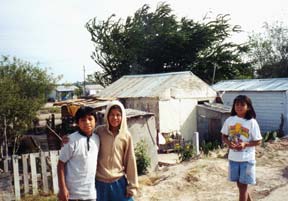
One of the great stories--and academic problems--of recent years has been the explosion of shanty, or squatters', settlements on the urban periphery in the developing world. Shantytowns are thought of as problems in much the same way--and for many of the same reasons--slums were in the late Victorian period.
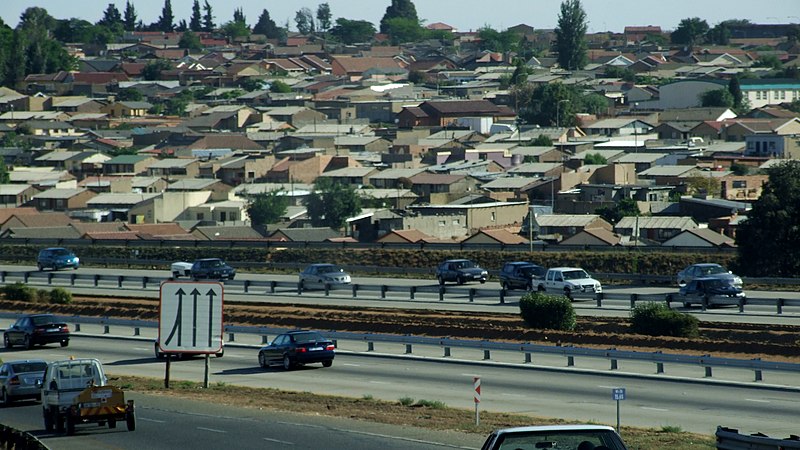 |
| Wealth-building in South Africa. View of improved section of Soweto. Cf. picture at bottom of post. |
Don't get me wrong: oftentimes the conditions in such places really
are appalling. Services taken for granted in the developed world, such as water and sanitation, are in many places nonexistent; and the housing stock is very
ad hoc, temporary, and unsafe, being built out of scraps like plywood and corrugated metal.
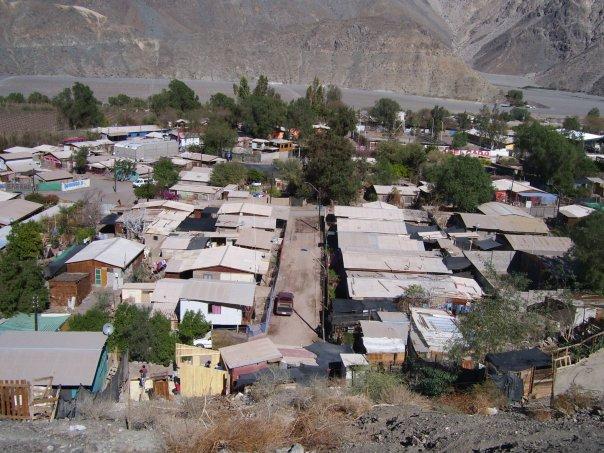 |
| A "campamento" in Chile, presumably in the suburbs of Santiago. |
But at the same time, there is a whiff of antiurban sentiment about them: since they all are, of a technicality, developed initially from various forms of informal housing*, the stereotype is that they are all like Kibera in Nairobi. The reality is something else.
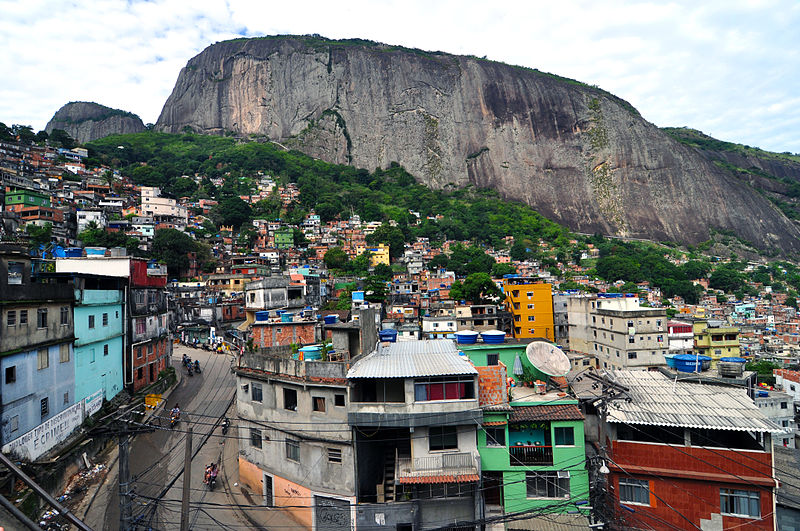 |
| Rocinha, Rio de Janeiro, Brazil |
There seem to be two major kinds of informal housing: true slums, like
Kibera, where, despite many years of settlement, the economy is subsistence--where residents relocate upon success, spawning a negative economic feedback cycle--and what could simply be thought of, and referred to, as informal development--where wealth
is being generated**, such as what is seen in Turkey, Brazil, or Indonesia, particularly evident in neighborhoods such as Rio's
Rocinha.
 |
| Ankara gecekondular |
In most cases, when wealth
is being generated in the community, such as in Rocinha, improvements in the built form take place. Where temporary materials such as cardboard and corrugation were once the dominant structural material, more permanent constructions, typically of cinder block decorated in local vernacular, take hold. These structures are reasonably structurally sound; the average structure in the Turkish
gecekondu***, for instance, has about the same structural strength as an American
dingbat.
 |
| Villa 31, Buenos Aires, Argentina |
One way of framing this distinction is by stating it terms of found versus vernacular architecture: a subtle distinction, for sure, but generally more work goes into vernacular architecture than into found architecture, and thus propagation of a vernacular is evidence of a move towards
comfort in addition to the need for
pure shelter...in other words, the ability to
afford comfort. Comparison of Brazilian
favelas and Turkish gecekondular against Kibera or "unimproved" (and thus still shantytown) parts of South African
townships, such as
Khayelitsha, demonstrate this basic dichotomy; again, Argentine
villas miserias, such as Buenos Aires' Villa 31 (shown above), show a greater level of comfort and dignity than e.g. shack sections of Soweto^ (shown below).
 |
| A true slum: shack dwellings in Soweto, South Africa. |
Let me end this post by getting to the point:
many so-called "slums" are actually spontaneously unslumming examples of emergent, everyday, or traditional urbanism; they are live communities where wealth-building is occurring. In other words, they are not slums, but rather emergent neighborhoods that need to be nurtured--not cleared.
___________
* In
Planet of Slums, Mike Davis points out how occupation-and-squatting tactics employed in the initial development of many of these areas has been since superseded by a variety of other informal tactics.
** As opposed to the true slum, where the
lack of generation of wealth (equity, often, in U.S. parlance) over the long term is a key economic attribute.
*** Pronounced
gay-gee-con-do. "C" has a
J sound in Turkish (which goes a long way towards explaining why
Azerbaijan has a "c" instead of "j" in Azeri--a language closely related to Turkish). The word is a compound word meaning "built by night" or "built overnight"; the plural is
gecekondular, with the addition of a syllable that is spectacularly impossible for East Asians to pronounce (
r and
l are assonant phonemes in most East Asian tongues, and assonant in a way that is precisely opposite the pronunciation of
-lar).
^ The history of South African townships is actually an interesting topic (albeit one for another day). Suffice it to say right now that Soweto actually happens to be one of the
wealthier historically-black townships in South Africa; a better example of true slum informal settlement on a large scale is Cape Town's Khayelitsha.